For ADHD, autistic and AuDHD brains
Reminders that wait until you can actually hear them.
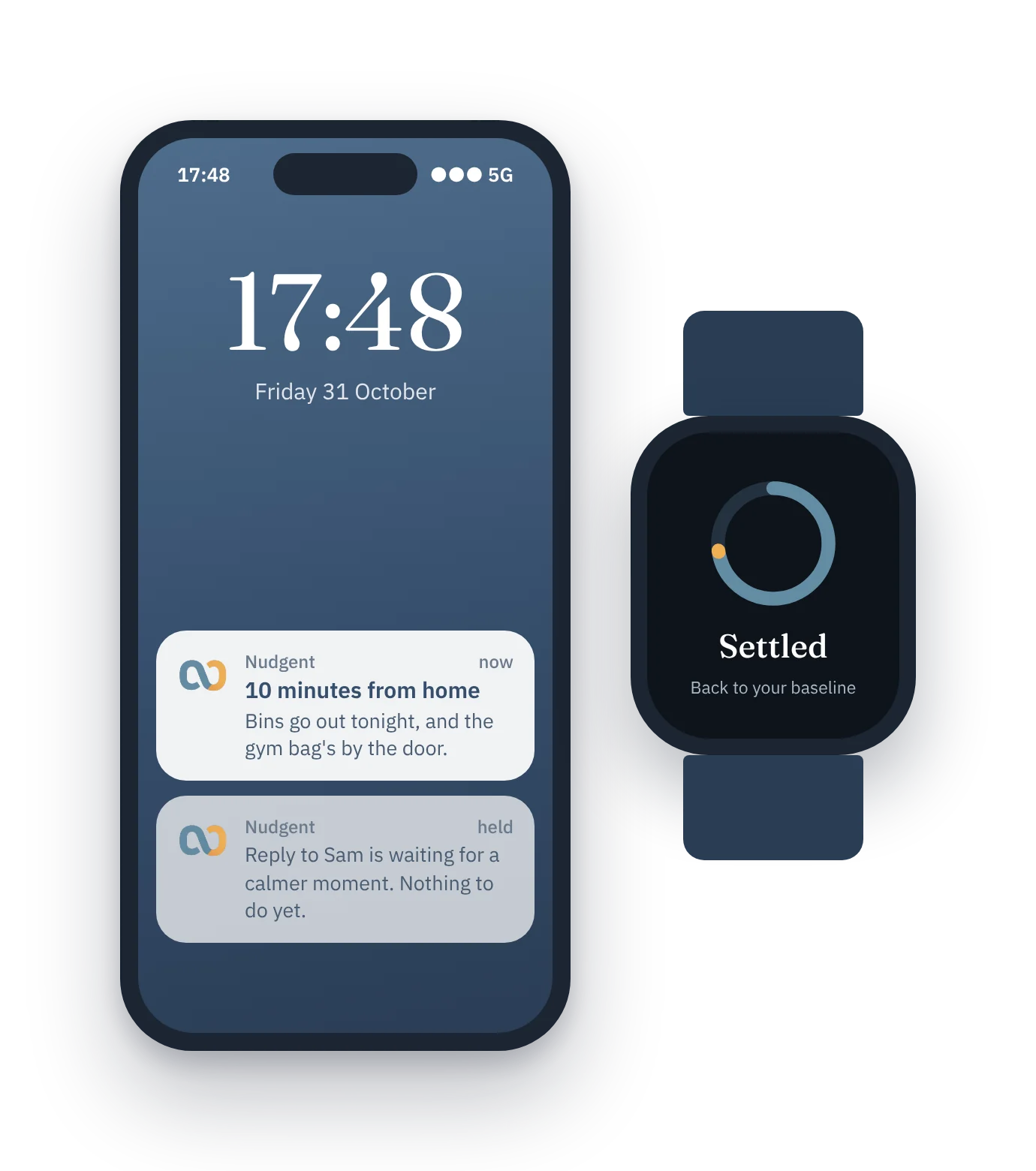
Nudgent reads your state — your heart rate variability, where you are, what's in your diary — and holds a nudge until you're settled enough to act on it. No pings mid-meltdown. No pile of red badges. No guilt.
 10 minutes from home. Bins go out tonight, and the gym bag's by the door.
Most reminder apps fire at the clock. Not at you.
A reminder at the wrong moment isn't neutral. When you're overloaded it's noise, and when it's missed it turns into one more thing you've "failed". Neurotypical tools weren't built for that.
Time blindness
"In an hour" means nothing. A timer going off doesn't make starting any easier.
The wrong moment
Pings land mid-overload, mid-hyperfocus, mid-drive — exactly when you can't act on them.
The shame stack
Overdue badges pile up until the app becomes a monument to everything you didn't do. So you stop opening it.
How it works
Three signals. One question: is now the right moment?
Your state
Heart rate variability from your watch, read against your own baseline over time. Not a number on a chart — a trend that tells Nudgent whether you're running hot or settled.
Where you are
Nudges that fire on arrival or as you leave. A ring at ten minutes from home, so you walk in braced, not ambushed. Gym, work, coffee shop, driving — each its own context.
Your diary
Nudgent spots patterns you can't. "A last-minute meeting has landed on Friday three weeks running." Unpredictable becomes predictable, just by watching.
Built around how your brain actually works.
Warning shots
"In ten minutes we move to the next thing." Transitions get braced for, not sprung.
The tiniest first step
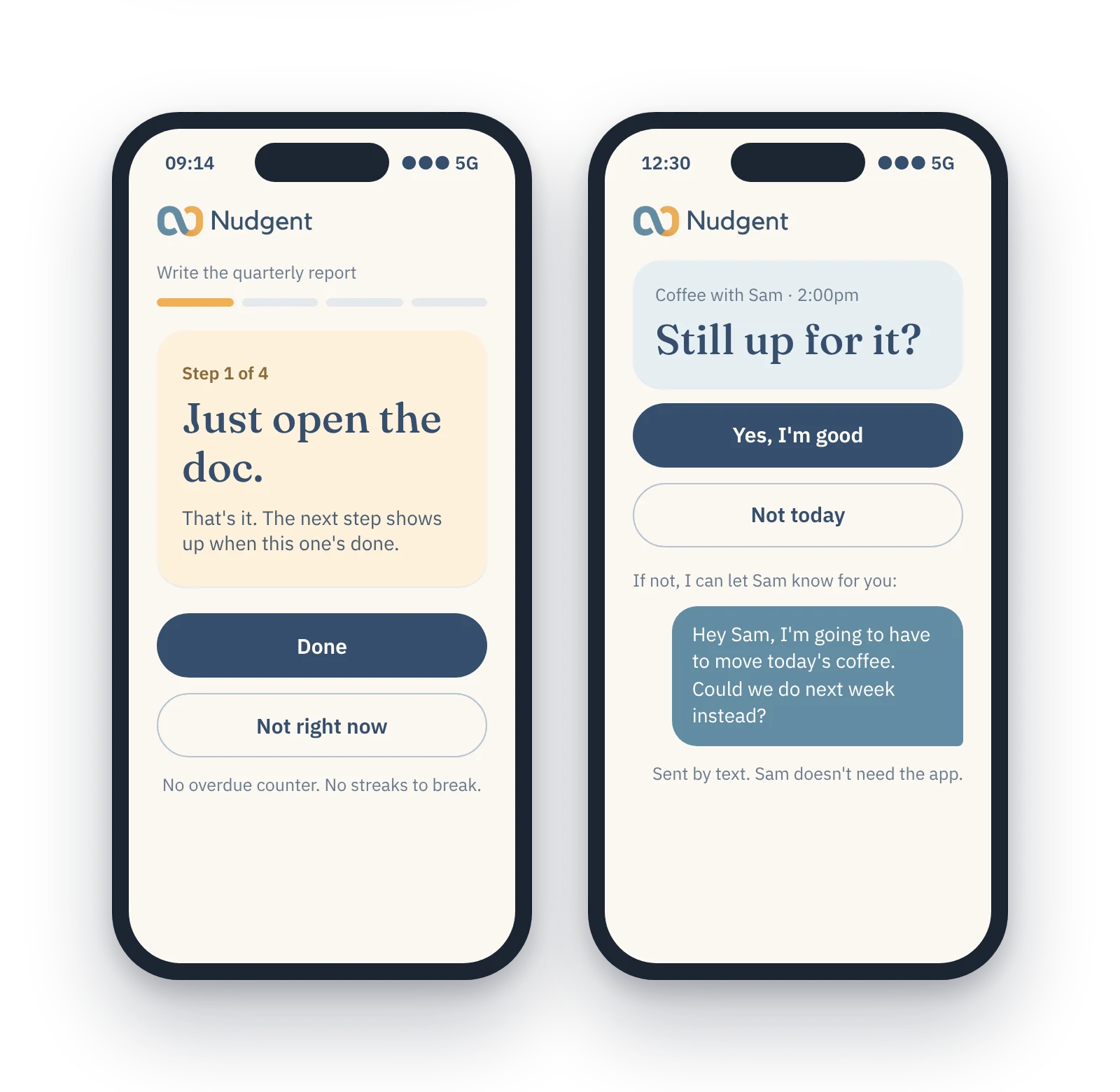
Not "write the report". Just "open the doc". One step at a time — the next appears when the last is done.
Hyperfocus aware
When you're locked in, it holds what can wait and reschedules by importance — and by whether other people are relying on you.
Burnout guard
"You've been in the red for three days." A tool that knows when to stop asking. On your side, not your boss's.
"Still up for it?"
Before a plan, a quiet check-in. If you're not, Nudgent can message the other person for you — even if they're not on the app.
Your transition times
You set how long you need between things. Nudgent plans around that, not around a neurotypical day.
Principles
It never piles on.
Missed something? Nudgent quietly reschedules it. No red stacks, no overdue counters, no scolding. The tone is a feature: if it feels like nagging, people stop opening it, and then nothing else matters.
- Gentle arrival. Soft glows and quiet escalation, never a klaxon.
- Your channel. Visual instead of sound, watch instead of phone — you choose.
- Short and clear. Icons, colour and a few words, not walls of text.
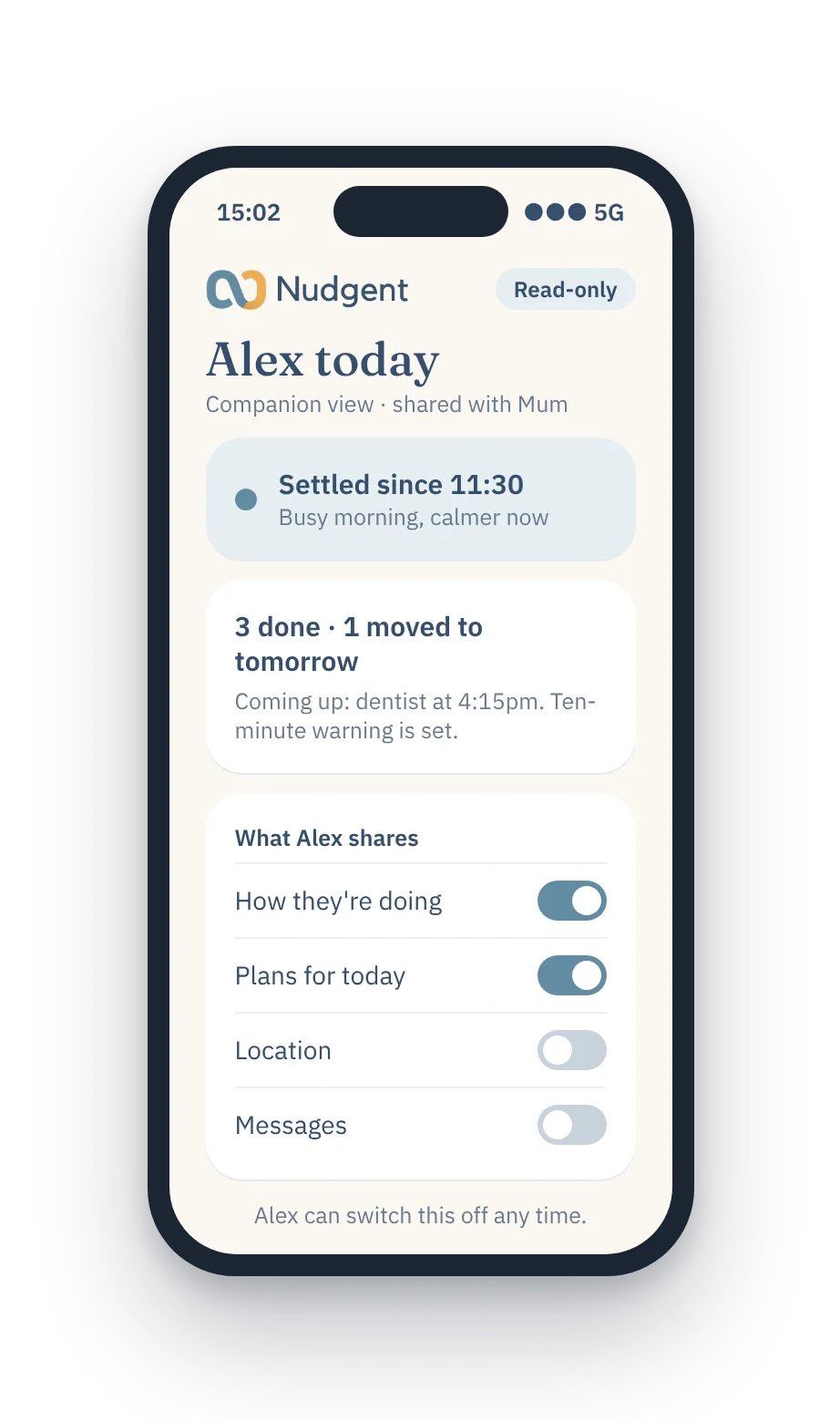
A view for the people who've got your back
Invite a carer, partner or parent to a read-only companion view. You decide exactly what they see — and you can switch it off whenever you like.
Your data stays yours
Nudgent learns your patterns to get better at timing — that's the point. It's not a medical device and doesn't diagnose anything. Your state is read as personal trends, never as a verdict.
Why it exists
Nudgent is built by Chris Kehoe, an AuDHD founder and advocate. He built it because he lives the problem: a reminder at the wrong moment is useless, or worse.
That's not something you get right from the outside. Every decision in Nudgent — the timing, the tone, the refusal to pile on — comes from living it.
Be one of the first to try it.
We're opening a one-week tester trial. Tell us what you'd want Nudgent to help with, and we'll be in touch.
Universities and organisations
Run a disability, wellbeing or inclusion service? We'd like to talk about bringing Nudgent to your students or staff.
hello@nudgent.co.uk